The proportion of borrowers defaulting on federal student loans continued to increase during the Great Recession, according to Education Department data released Monday.
The two-year "cohort" default rate, which represents the proportion of federal loan borrowers who entered repayment between October 2008 and September 2009 and had defaulted on their loans by the end of September 2010, increased to 8.8 percent, the highest such rate since 1997. The rate increased 1.8 percentage points from fiscal 2008.
While students in all sectors were likelier to default on their loans than they had been the previous year, defaults increased the most at for-profit colleges: 15 percent of borrowers from those institutions defaulted in 2009, compared with 11.6 percent in 2008. That was more than twice the rate at public and not-for profit private institutions. Critics have compared for-profit colleges' exhorbitant tuitions and the huge federal loans students take out to pay them to the sub-prime mortgage bubble that led to the Great Recession.
Defaults increased to 7.2 percent at public institutions, from 6 percent in the 2008 fiscal year. At private institutions, the default rate increased from 4 percent in 2008 to 4.6 percent in 2009.
The rates are the first to consist entirely of loans that entered repayment during the worst of the economic downturn, and Education Department officials pointed to the bad economic situation as a major factor in the increase in defaults. Defaults tend to increase as unemployment rises, and delinquency rates on other types of credit, such as mortgages and credit cards, increased during the same period, they said.
But officials also pointed to booming enrollments at for-profit colleges as a contributing factor. Default rates have historically been higher for students at for-profit institutions. Nearly half of the 320,000 defaulting borrowers who began repayment in fiscal 2009 were enrolled at for-profit colleges, said James Kvaal, the deputy undersecretary for education, during a conference call with reporters.
Since fiscal year 2005, default rates over all have nearly doubled, from 4.6 percent in 2005 to 2009’s 8.8 percent. Still, default rates are far from their peak in 1990, when 22.4 percent of students defaulted on their loans and the Education Department shut down dozens of programs.
The department cautioned that the actual default rate may in fact be higher, because many colleges encourage their students to seek forbearance or defer payments rather than go into default. While that sometimes can help students repay their loans, in many cases it just delays the default beyond the two-year window, Kvaal said. The Project on Student Debt called Monday’s figures “the tip of the iceberg,” noting that most defaults occur after two years.
Next year, the department will begin using three-year default rates to evaluate programs, meaning that the rate will increase. Trial three-year default rates for 2009 will be released in spring 2012.
Five institutions, four of them for-profits, will lose eligibility for federal student loans due to high default rates: Tidewater Technical, in Norfolk, Va.; Trend Barber College in Houston; Missouri School of Barbering and Hairstyling in St. Louis; Sebring Career School, in Houston, and Human Resource Development and Employment-Stanley Technical Institute, in Clarksburg, W.V. Institutions must have default rates that exceed 40 percent in one year or 25 percent for three consecutive years to incur sanctions.
Showing posts with label student loan default rates. Show all posts
Showing posts with label student loan default rates. Show all posts
Tuesday, September 13, 2011


Thursday, July 22, 2010
Economist asks if for-profit colleges are "monsters in the making?"
The Economist
July 22nd 2010 Chicago
IT SEEMS too good to be true, at least for companies. Customers arrive at for-profit colleges by the million. With them comes billions of dollars of federal student grants and loans, to be poured into corporate coffers. Public subsidies may provide up to 90% of revenue; the government bears the risk of loan defaults. This business model has served firms rather well. Its effect on students and taxpayers is less clear.
This summer, however, a brawl over for-profit colleges has exploded at last.
On May 26th Steven Eisman, a big shorter, warned investors that for-profit colleges could echo subprime mortgages. June brought a Senate hearing (including testimony from Mr Eisman, to the industry’s horror) and proposed regulations from the Education Department. As The Economist went to press the department was expected to release another, even more controversial rule. Behind this fight lies a new, rather uncomfortable urgency. For-profit colleges have happily depended on government support. Now education may increasingly come to depend on for-profit colleges.
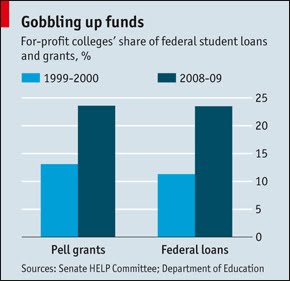
Proprietary colleges have morphed into behemoths, some of them publicly traded companies that reach hundreds of thousands of students in classrooms and online. Enrolment jumped by 225% between 1998 to 2008, more than seven times the rate for all post-secondary programmes. The recession has accelerated this trend. The Apollo Group’s University of Phoenix, the biggest proprietary college, now enrolls 476,500 students. With more students comes more public money. In 2008-09 $24 billion in Pell grants and federal loans went to for-profit colleges.
The return on investment is harder to calculate. The industry is shrouded in fuzzy numbers. Reliable graduation rates and earnings data do not exist. More certain, however, is that the debt burden and default rates for graduates are particularly high. In 2009 the average yearly tuition was about $14,000, compared with $2,500 at a community college. Critics claim that misleading recruiting lures students into programmes that leave them with heavy debt and flimsy skills. Of post-secondary investigations by the Education Department, 70% are related to proprietary schools. Litigation is common. In 2009 Apollo agreed to pay $78.5m to settle a suit over pay schemes for recruiters.
The Education Department is trying to fix these problems. It has proposed requiring schools to give more information about fees, graduation rates and job placement. Schools would not be able to tie recruiters’ pay to their enrolment numbers. The most controversial idea, to cap students’ yearly debt obligations to a small share of income after graduation, will be formally proposed any day now. Harris Miller of the Career College Association contends that such a change would force thousands of good programmes to shut.
Final regulations are expected by November. Further legislation may come from Tom Harkin, who is leading Senate hearings on the industry. Changes are needed—and soon—not merely to protect students and taxpayers. For despite all the criticism, proprietary colleges look likely to become ever more necessary.
Barack Obama has set a goal of having the world’s highest share of college graduates by 2020. Proprietary schools offer flexible classes for those with jobs, children or remote homes. More important, community colleges are severely strained. Though federal student aid has risen, a plan to support community colleges was all but gutted in March. States are overwhelmed by growing demand and shrinking budgets. California estimates that tight capacity forced community colleges to turn away 140,000 students this year. It is no coincidence that Kaplan, a for-profit college, has signed a controversial agreement to tap the state’s glut of students. Mr Miller is defiant. “No one wants to talk about how the capacity expansion has to come from somewhere,” he says. In 2008 for-profit colleges accounted for 7.7% of all post-secondary enrolment. For better or worse, that share is likely to grow.
Wednesday, June 9, 2010
Hedge funds target for-profit colleges
According to Hedgetracker.com :
Hedge funds have been circling for new carrion to devour in the next economic slowdown and have found a big fat target in the for-profit educational sector. The industry is ripe for the taking. For two decades, for-profit schools have lured gullible students with inflated promises of impressive sounding degrees which they pay exorbitant tuition to obtain.
In education's version of the subprime crisis, creative financial aid departments obtain government loans to finance the entire program. There are now over 2 million attending these institutions, accounting for 10% of all higher education in the US, and the profits that have poured in have been absolutely massive.
Early investors rode the IPO train all the way to the bank. The problem arises when few students ever achieve these laudable goals. According to government statistics, 55% of US college students obtain a degree within six years. At the University of Phoenix, with 400,000 students, the largest for-profit university, only 18% meet this deadline, only 6% at some campuses, and a mere 4% of online students. Dropouts end up defaulting on loans that can amount to as much as $100,000 for incomplete bachelor's degrees and up to $200,000 for advanced degrees.
It now looks like the gravy train is about to end. Secretary of Education Arne Duncan has promised a crack down on the industry, bringing in more regulation and prosecutions of deceptive marketing practices, where degree programs are sold like time shares. The leading accreditation organizations are also having second thoughts about the for-profits, where 95% of the instructors are part time and tenure is unknown. Complaints are rife about shoddy teaching standards and missing doctorates.
The government has funded $750 billion in student loans, and while 10% of public University loans go unpaid, the default rate at for-profit schools is thought to be as high as 50%. Starve these schools of subsidized government funding, and their shares are history. (emphasis is mine)
Take a look at the top listed for-profit universities of Apollo (APOL), Capella Education (CPLA), and DeVry (DV).
According to HedgeTracker, top hedge fund holders of Apollo as of 3/31/10 include Chase Coleman’s Tiger Global Management with 6,754,212 shares / $414mm, Lee Ainslie’s Maverick Capital with 5,683,992 shares / $348mm, Ricky Sandler’s Eminence Capital with 1,844,891 shares / $113mm, and John Paulson’s Paulson & Co. with 1,600,000 shares / $98mm.
All of the above mentioned hedge funds, except Tiger Global, made HedgeTracker’s Top Hedge Fund list of 2009.
Top hedge fund holders of Capella Education include Jim Simons’ Renaissance Technologies with 366,425 shares / $34mm and Maverick Capital with 209,669 shares / $19mm.Top hedge fund holders of DeVry include Ken Griffin’s Citadel Investment Group with 421,284 shares / $27mm and Ravi Kaza’s Seasons Capital Management with 305,223 shares / $20mm.
For Detailed Investor Profiles on these Investors, click below:
Citadel Investment Group
Maverick Capital
Renaissance Technologies Corporation
Seasons Capital Management
Tiger Global Management
Related People: Brandon Haley; Becket Wolf; Charles Wyly; Chase Coleman; David Grossman; David Hensle; Derek Kaufman; Evan Wyly; Feroz Dewan; Jeff Runnfeldt; Jim Simons; Julian Robertson; Kaveh Alamouti; Kenneth Griffin; Lee S. Ainslie; Mark Stainton; Neeraj Chandra; Ravi Kaza; Ryan Garino; Sam Wyly; Steve Weller
Related Entities: Citadel Alternative Asset Management; Citadel Equity Fund; Citadel Kensington; Citadel Wellington; Equiduct; Maverick Capital Long LP; Maverick Fund USA; Maverick Levered Partners; Medallion; New Castle Re; Nova; Renaissance Institutional Equities Funds; Seasons Aggressive Fund; Seasons Core Fund; Seasons Institutional Core Fund LP; Seasons Leveraged Core; Sowood Capital*; Tiger Global Funds; Tiger Management Corporation; Tiger Management Corporation*; Tiger Technology LP
Hedge funds have been circling for new carrion to devour in the next economic slowdown and have found a big fat target in the for-profit educational sector. The industry is ripe for the taking. For two decades, for-profit schools have lured gullible students with inflated promises of impressive sounding degrees which they pay exorbitant tuition to obtain.
In education's version of the subprime crisis, creative financial aid departments obtain government loans to finance the entire program. There are now over 2 million attending these institutions, accounting for 10% of all higher education in the US, and the profits that have poured in have been absolutely massive.
Early investors rode the IPO train all the way to the bank. The problem arises when few students ever achieve these laudable goals. According to government statistics, 55% of US college students obtain a degree within six years. At the University of Phoenix, with 400,000 students, the largest for-profit university, only 18% meet this deadline, only 6% at some campuses, and a mere 4% of online students. Dropouts end up defaulting on loans that can amount to as much as $100,000 for incomplete bachelor's degrees and up to $200,000 for advanced degrees.
It now looks like the gravy train is about to end. Secretary of Education Arne Duncan has promised a crack down on the industry, bringing in more regulation and prosecutions of deceptive marketing practices, where degree programs are sold like time shares. The leading accreditation organizations are also having second thoughts about the for-profits, where 95% of the instructors are part time and tenure is unknown. Complaints are rife about shoddy teaching standards and missing doctorates.
The government has funded $750 billion in student loans, and while 10% of public University loans go unpaid, the default rate at for-profit schools is thought to be as high as 50%. Starve these schools of subsidized government funding, and their shares are history. (emphasis is mine)
Take a look at the top listed for-profit universities of Apollo (APOL), Capella Education (CPLA), and DeVry (DV).
According to HedgeTracker, top hedge fund holders of Apollo as of 3/31/10 include Chase Coleman’s Tiger Global Management with 6,754,212 shares / $414mm, Lee Ainslie’s Maverick Capital with 5,683,992 shares / $348mm, Ricky Sandler’s Eminence Capital with 1,844,891 shares / $113mm, and John Paulson’s Paulson & Co. with 1,600,000 shares / $98mm.
All of the above mentioned hedge funds, except Tiger Global, made HedgeTracker’s Top Hedge Fund list of 2009.
Top hedge fund holders of Capella Education include Jim Simons’ Renaissance Technologies with 366,425 shares / $34mm and Maverick Capital with 209,669 shares / $19mm.Top hedge fund holders of DeVry include Ken Griffin’s Citadel Investment Group with 421,284 shares / $27mm and Ravi Kaza’s Seasons Capital Management with 305,223 shares / $20mm.
For Detailed Investor Profiles on these Investors, click below:
Citadel Investment Group
Maverick Capital
Renaissance Technologies Corporation
Seasons Capital Management
Tiger Global Management
Related People: Brandon Haley; Becket Wolf; Charles Wyly; Chase Coleman; David Grossman; David Hensle; Derek Kaufman; Evan Wyly; Feroz Dewan; Jeff Runnfeldt; Jim Simons; Julian Robertson; Kaveh Alamouti; Kenneth Griffin; Lee S. Ainslie; Mark Stainton; Neeraj Chandra; Ravi Kaza; Ryan Garino; Sam Wyly; Steve Weller
Related Entities: Citadel Alternative Asset Management; Citadel Equity Fund; Citadel Kensington; Citadel Wellington; Equiduct; Maverick Capital Long LP; Maverick Fund USA; Maverick Levered Partners; Medallion; New Castle Re; Nova; Renaissance Institutional Equities Funds; Seasons Aggressive Fund; Seasons Core Fund; Seasons Institutional Core Fund LP; Seasons Leveraged Core; Sowood Capital*; Tiger Global Funds; Tiger Management Corporation; Tiger Management Corporation*; Tiger Technology LP
Subscribe to:
Posts (Atom)